

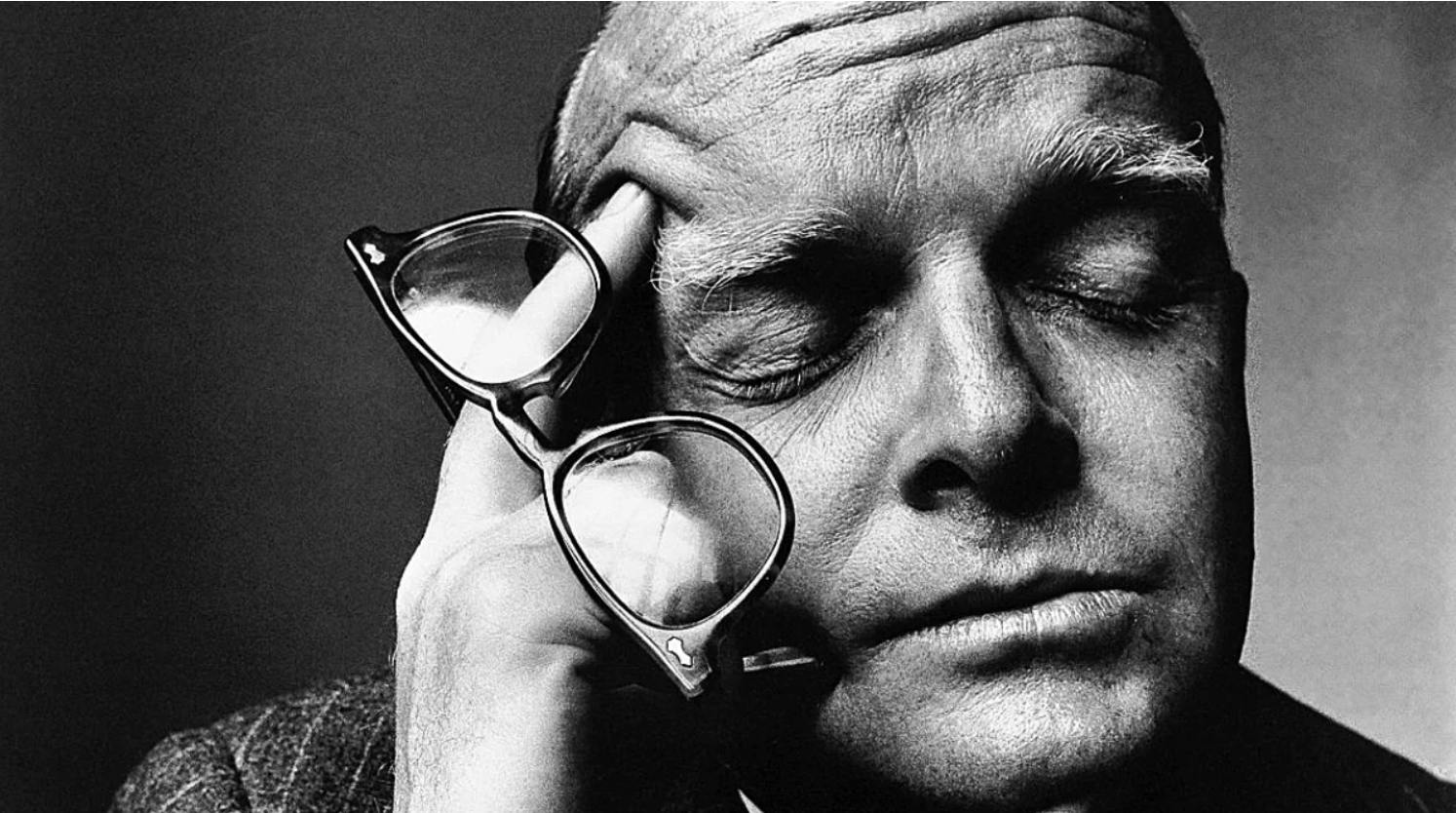
The Troubled & Troublesome Truman Capote
Once, the 5-3 author arm-wrestled — AND DEFEATED — Humphrey Bogart on the movie set of Beat The Devil. He so offended American Poet Laureate Robert Frost that Capote lost his job at New Yorker Magazine over it. He hated that Audrey Hepburn was cast as Holly Golightly in Breakfast at Tiffany’s. Though he had been friends with Harper Lee since their childhood days in Alabama, Capote tried to take credit for writing Mockingbird.
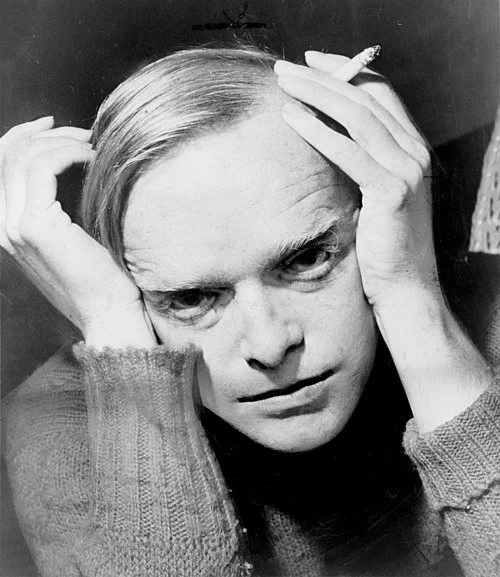
TALENTED. COMPLICATED. CONTROVERSIAL. — Truman Capote is one of America’s most gifted and hard-working writers who ended up leaving more enemies than friends. / Library of Congress
YOU COULD ALMOST LOOK UP THE WORD, ‘QUIRKY’ in a dictionary and find Truman Capote’s picture there. He was superstitious. He never began, or ended, a writing project on any Friday. If he had checked into a hotel and the room phone had the number, “13” in it, he’d scamper out and change rooms.
Capote is famous for penning such modern classics as Breakfast at Tiffany’s and In Cold Blood. The latter? For six years, his good friend, author of To Kill A Mockingbird, Harper Lee, helped him research and write it. In turn, Lee probably modeled one of her lead characters in Mockingbird — Dill Harris — after Capote. An emotionally damaged and lonely child, the impish lad, starting at the age of 5, went everywhere with a dictionary and note pad.
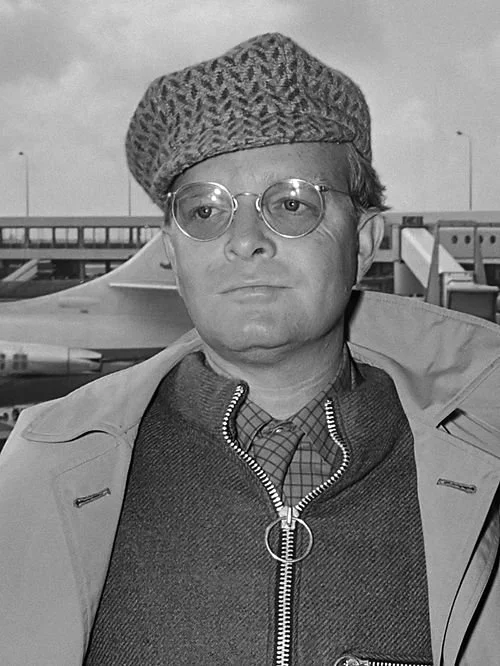
TRAGIC JET-SETTER — Despite touring with The Rolling Stones and rubbing elbows with some of the richest and most famous people on earth, Capote died leaving hundreds of thousands in debt, from various New York restaurants to Joanne Carson (Johnny’s ex). He even ended up owing a quarter-million on his funeral. / 1958 Public Domain
When he was a mere 11, he changed his name from Truman Streckfus Persons to Truman Garcia Capote in 1935. Of course, it wasn’t exactly an on-purpose move. His mother, who would commit suicide, remarried to a Cuban ex-colonel whose name was Jose Garcia Capote.
The neurotic young man was inducted into the armed services during World War II, but didn’t make the cut. He told a friend he was, “turned down for everything, including the WACS.”
Once in a 1978, the hard-living Capote showed up to an on-air interview completely drunk and was asked by host Stan Siegel: “What's going to happen unless you lick this problem of drugs and alcohol?” Capote’s answer: “Eventually, I mean, I’ll kill myself ... without meaning to.” His writing style? He mostly wrote lying down, surrounded by coffee, booze and cigarettes.
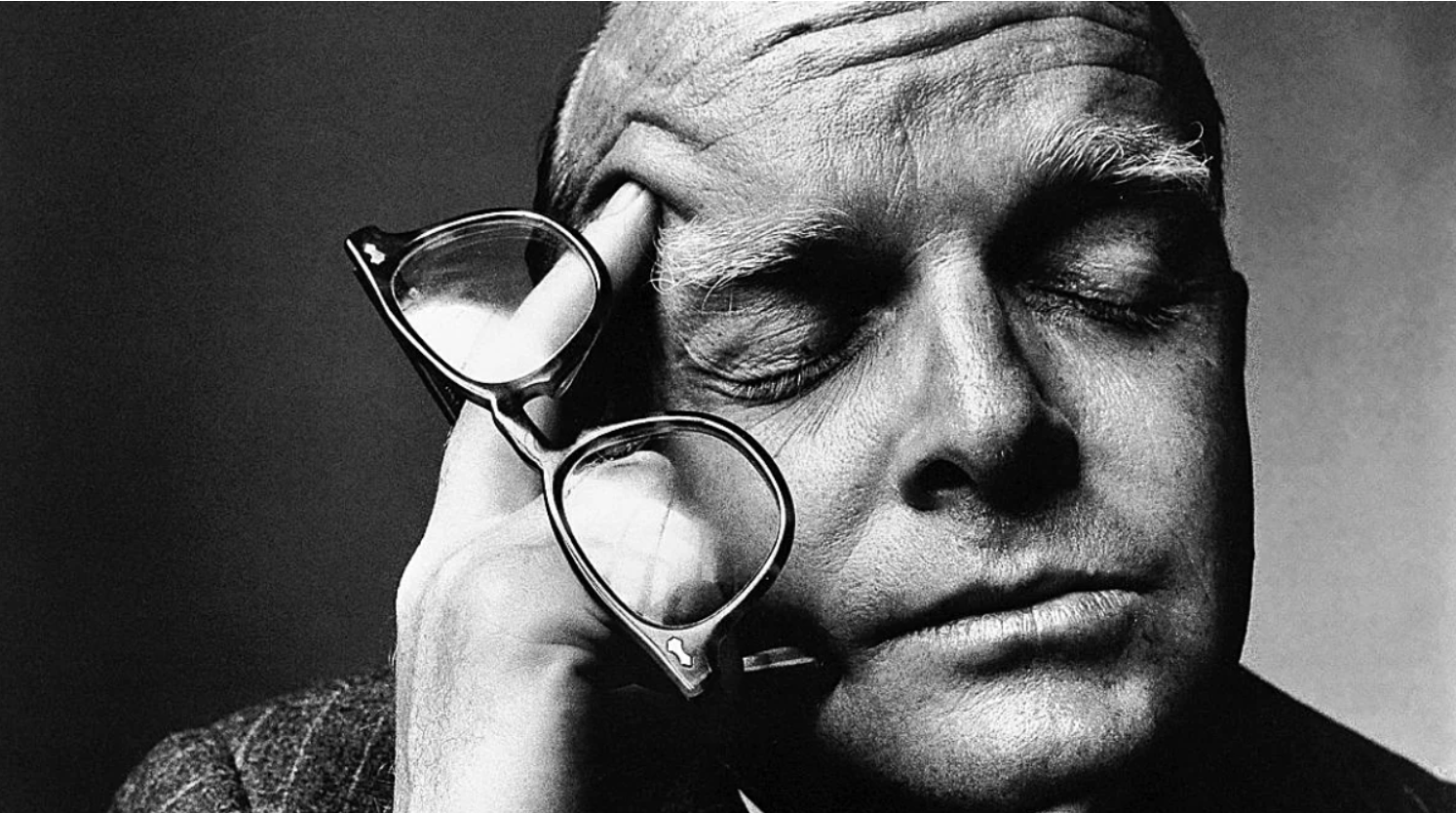
OF COURSE YOU HAVE J&B — The alcoholic Capote drank daily and one of his habits was to walk down the the corner liquor store. His favorite hard liquor was to ask for a bottle of “Justerini and Brooks” scotch, which is the official name for the famous J&B brand. If the clerk didn’t know what “Justerini and Brooks” stood for or said he didn’t carry that brand, Capote would walk out without buying anything and suffer all night from his choice. / Photo by Moscot
Capote was a jet-setter who feuded with a Who’s Who, from Gore Vidal to Jacqueline Kennedy Onassis. Once, the 5-3 author arm-wrestled — AND DEFEATED — Humphrey Bogart on the movie set of Beat The Devil. He so offended American Poet Laureate Robert Frost that Capote lost his job at New Yorker Magazine over it. He hated that Audrey Hepburn was cast as Holly Golightly in Breakfast at Tiffany’s. Though he had been friends with Harper Lee since their childhood days in Alabama, Capote tried to take credit for writing Mockingbird. He was stalked relentlessly by a young artist, whom Capote once described as, “one of those hopeless people you know nothing’s ever going to happen to.” The artist was Andy Warhol.
Capote is the seventh cousin, once-removed, to playwright Tennessee Williams.

The Plague — er, um — EGG & I
Before it was one of America’s hottest movie franchises, Betty MacDonald’s hilarious autobiography was No. 1 on the NYTimes Bestseller List for 43 straight weeks.
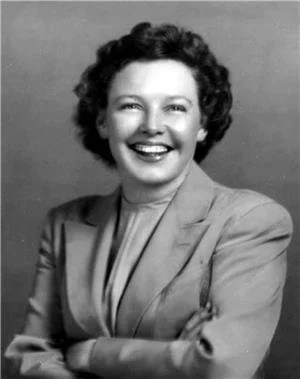
The wonderful and somewhat forgotten mid-20th century humorist, Betty MacDonald.
THIS MAY SEEM LIKE OLD-TIMEY FILM TRIVIA, BUT — really? The Egg & I is about the hit 1945 autobiography from the pen of Washington state humorist, Betty MacDonald.
To be sure, there’s lots of neat factoids surrounding the ten E&I films, only the first starring Claudette Colbert and Fred MacMurray. The latter thespian often played clean-as-a-whistle leading man, including his hit 1960-72 TV sitcom, My Three Sons. It can be argued that in real life, MacMurray enjoyed a not-too-delightful reputation amongst handymen.
Word got out he’d hire someone from the blue collar demographic for some Coldwater Canyon home project, then, fire them half-way through so he wouldn’t have to pay them. When a craftsman driving by would see a work truck in the actor’s driveway, they’d stop and leave a warning note to leave.
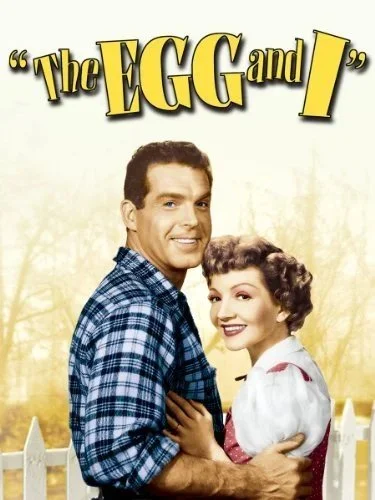
Before it was a giant mid-20th-century film series, The Egg & I was one of the hottest bestsellers of its era. Small World Dept.? My father-in-law, Ed Muhl, produced the film for Universal.
The original Egg & I franchise, co-starred the farm couple, Ma & Pa Kettle. Character actress Marjorie Main would earn an Oscar nom as Ma and who would star in all the flicks. MacDonald’s autobio would be on the bestseller lists for years (being No. 1 on The New York Times Bestseller List for 43 straight weeks!) and sell more than 3 million hardcover copies, with editions in 32 languages.
It would be reprinted every month for years. Author MacDonald received $100,000 for the film rights in 1945, which would be about $1.5 million today. Because of the then-dicey subject matter of the heroine’s divorce in the book, that particular part of the story wasn’t adapted to the screenplay. In real life, Betty’s alleged crumb of a hubbie was murdered in Northern California. We’re told Betty had all sorts of alibis. (:- )
MacDonald, her Lippincott publisher and a Seattle department store that sold the book were sued for nearly $1 million by members of a Washington-based Ketchum family and the local Native American Chimicum tribe. Both claimed they were unfairly characterized and subjected to ridicule. MacDonald settled out of court for a much smaller amount with the Ketchum family.
A Seattle judge, William Willkins, threw out the second, $1 million libel suit. MacDonald’s attorneys pointed out that one of the family members was simply trying to profit from the fame of being associated with the films. Seems the fellow, who played the character, “Crowbar,” had appeared in a local community theater performance with a pair of chickens under his armpits.
Oh. Justice Willkins? He had been one of the jurists on the famous post-World War II Nurenberg Nazi trial.
Like many writers, famous and not-so, Betty MacDonald (perhaps as in, “Old MacDonald had a you-know-what?) was not her real name. The author’s birth certificate handle was a tad more Shakespearean — Anne Elizabeth Campbell Bard.
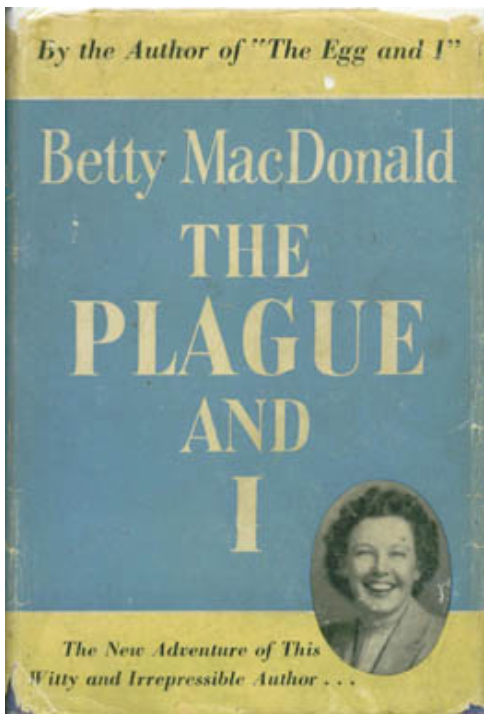
If there were ever a writer who could make fun of themselves having the plague, it would be Betty…
MacDonald wrote several other books, including the autobiographical recollections of staying in a Washington-state sanatorium for tuberculosis sufferers. Her book was entitled, The Plague and I.
The New York Times paragraphist who reviewed P&I wrote:
“Betty MacDonald … apparently can extract more amusement out of a nasty experience than most people can corral out from a trip to the circus…the artistry of her style, the infectious gaiety of her perspective, and the sensitive understanding she extends to any person she comes in contact with…assures a good deal of pleasure and vital knowledge even though as a subject the plague’s the thing.”
However, rotten little carrion feeders they can be, in 1984, a different NYT followed up, calling MacDonald’s The Plague and I — “undeservedly forgotten.”
Born on March 26, 1907 in Boulder, Colorado, MacDonald died young at 50 on February 7, 1958.

John Steinbeck: O’ Rare Werewolf Writer
YOU CAN’T ALWAYS BELIEVE IN SYNTAX, the internet, biographers or trivia blogs. It is documented that John Steinbeck used 300 pencils to write East of Eden. Okay. Fine. But then, a biographer claimed he used, “…up to 60 pencils in a day. So. If my math’s correct, it took Steiny just five days to write East of Eden? He won a Nobel Prize, a Pulitzer Prize and two Oscars for his work. His first book was a failed werewolf novel, set in Lake Tahoe. He mentions this in a meeting with Mike Fenberg, protagonist in Naked Came The Novelist. Betcha didn’t know Johnny’s real name wasn’t Steinbeck. It’s “Grossteinbeck.” His paternal grandpapa knocked off the “Gross” when he immigrated from Germany to America.
John was one unhealthy kid. At 16, he almost died from pleural pneumonia and a doctor saved his life by cutting through his rib cage to drain fluid from his lungs. Same year? Had his appendix removed. (Steinbeck; not the doctor) He had a fractured knee cap, back injuries, a renal infection, stroke, a compromised immune system, and, worse? He finally died, in December of 1968.

YOU CAN’T ALWAYS BELIEVE IN SYNTAX, the internet, biographers or trivia blogs. It is documented that John Steinbeck used 300 pencils to write East of Eden. Okay. Fine. But then, a biographer claimed he used, “…up to 60 pencils in a day. So. If my math’s correct, it took Steiny just five days to write East of Eden? He won a Nobel Prize, a Pulitzer Prize and two Oscars for his work. His first book was a failed werewolf novel, set in Lake Tahoe. He mentions this in a meeting with Mike Fenberg, protagonist in Naked Came The Novelist. You’ve heard that old kid’s excuse of “My dog ate my homework?” That happened to Steinbeck, but it was a novel. His dog, Toby, ate a good chunk of his original manuscript, written in pencil, “Of Mice and Men.” Toby’s aperitif caused Steinbeck to have to rewrite from memory and delayed publication of the 1937 classic.
Steinbeck made three trips to the former Union of Soviet Socialist Republics. His pro-labor writings earned him a tale from the FBI.
Betcha didn’t know Johnny’s real name wasn’t Steinbeck. It’s “Grossteinbeck.” His paternal grandpapa knocked off the “Gross” when he immigrated from Germany to America.
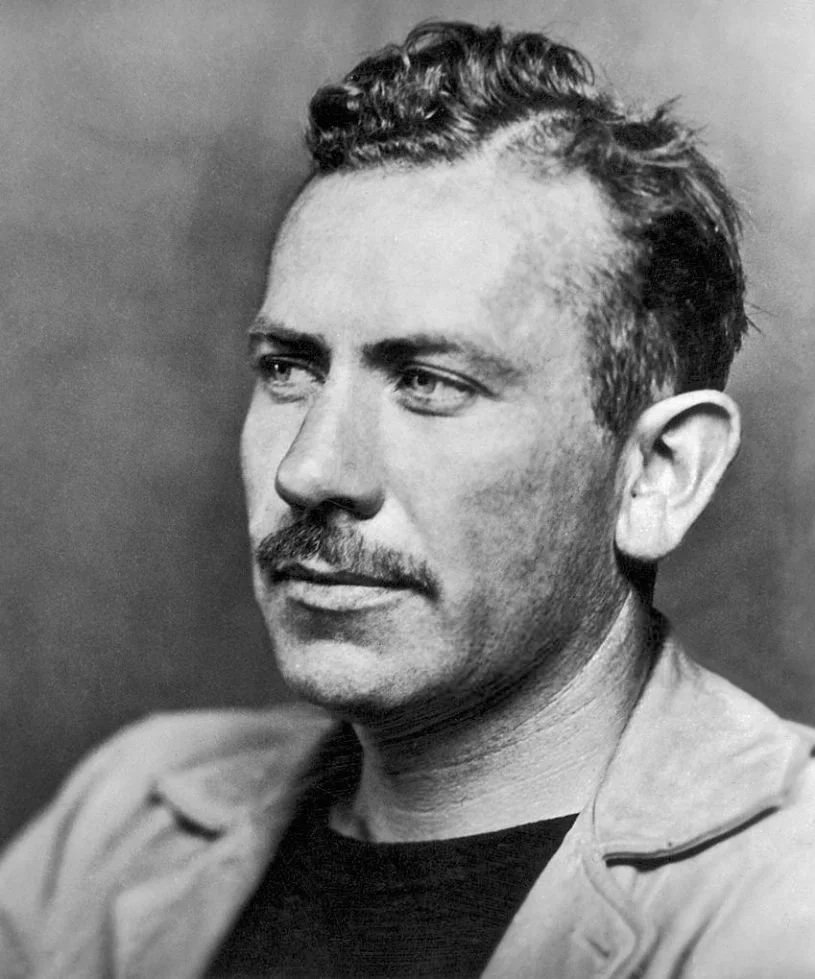
John was one unhealthy kid. At 16, he almost died from pleural pneumonia and a doctor saved his life by cutting through his rib cage to drain fluid from his lungs. Same year? Had his appendix removed. (Steinbeck; not the doctor) He had a fractured knee cap, back injuries, a renal infection, stroke, a compromised immune system, and, worse? He finally died, in December of 1968.
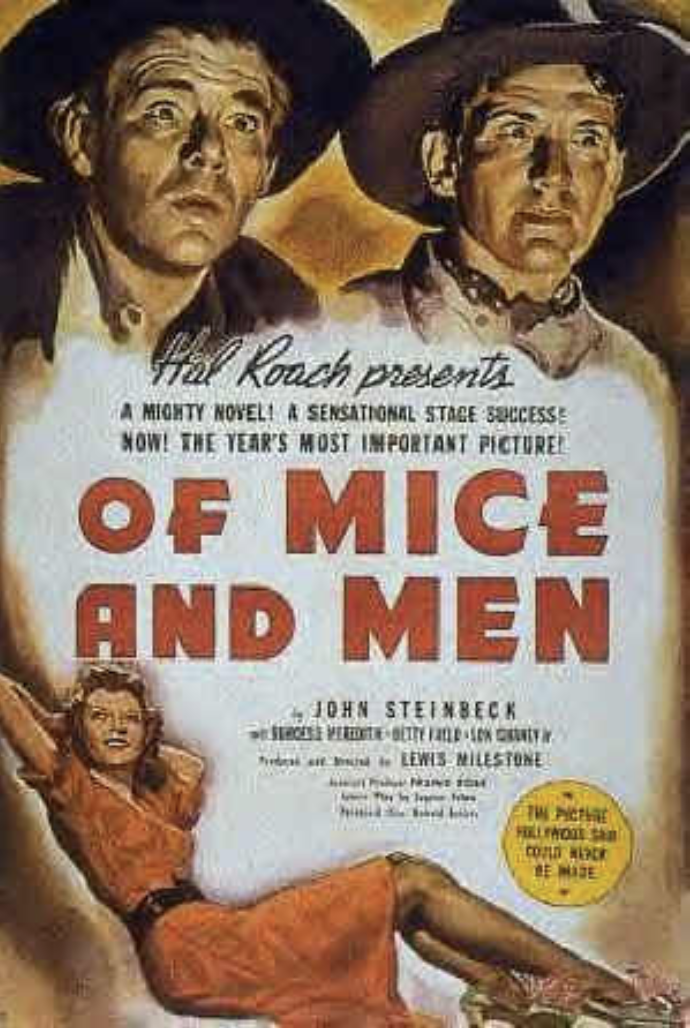
Seventeen of Steinbeck’s works were turned into films, including the above. In high school, I played the Burgess Meredith character of George. My pal, Jim Brandt, played Lenny. I’d like to tease that Jim wasn’t acting, but, actually, Master Brandt, besides being huge, was brain scientist smart….

Blog Post Title Two
It all begins with an idea.
It all begins with an idea. Maybe you want to launch a business. Maybe you want to turn a hobby into something more. Or maybe you have a creative project to share with the world. Whatever it is, the way you tell your story online can make all the difference.
Don’t worry about sounding professional. Sound like you. There are over 1.5 billion websites out there, but your story is what’s going to separate this one from the rest. If you read the words back and don’t hear your own voice in your head, that’s a good sign you still have more work to do.
Be clear, be confident and don’t overthink it. The beauty of your story is that it’s going to continue to evolve and your site can evolve with it. Your goal should be to make it feel right for right now. Later will take care of itself. It always does.

Blog Post Title Three
It all begins with an idea.
It all begins with an idea. Maybe you want to launch a business. Maybe you want to turn a hobby into something more. Or maybe you have a creative project to share with the world. Whatever it is, the way you tell your story online can make all the difference.
Don’t worry about sounding professional. Sound like you. There are over 1.5 billion websites out there, but your story is what’s going to separate this one from the rest. If you read the words back and don’t hear your own voice in your head, that’s a good sign you still have more work to do.
Be clear, be confident and don’t overthink it. The beauty of your story is that it’s going to continue to evolve and your site can evolve with it. Your goal should be to make it feel right for right now. Later will take care of itself. It always does.

Blog Post Title Four
It all begins with an idea.
It all begins with an idea. Maybe you want to launch a business. Maybe you want to turn a hobby into something more. Or maybe you have a creative project to share with the world. Whatever it is, the way you tell your story online can make all the difference.
Don’t worry about sounding professional. Sound like you. There are over 1.5 billion websites out there, but your story is what’s going to separate this one from the rest. If you read the words back and don’t hear your own voice in your head, that’s a good sign you still have more work to do.
Be clear, be confident and don’t overthink it. The beauty of your story is that it’s going to continue to evolve and your site can evolve with it. Your goal should be to make it feel right for right now. Later will take care of itself. It always does.